

CO₂-Derived Chemicals Market Outlook: Europe Leads Carbon Utilization Revolution with Covestro AG
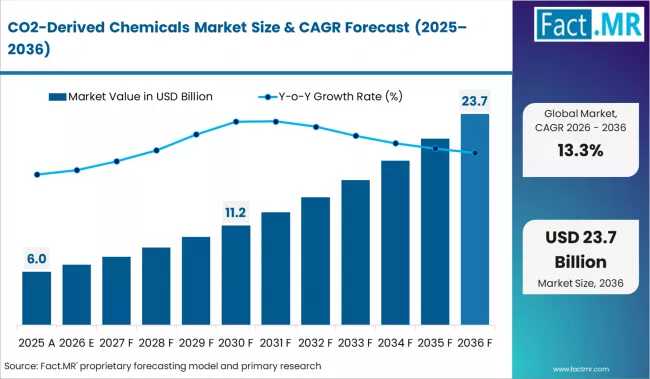
CO₂-Derived Chemicals Market
CO2-Derived Chemicals Market is segmented by Product Type (Alcohols and Platform Chemicals, Polymers and Plastics, Building Materials, Fuels and Intermediates)
ROCKVILLE, MD, UNITED STATES, March 28, 2026 /EINPresswire.com/ -- The global CO2-derived chemicals market, valued at USD 5.7 billion in 2025, is entering a decade of aggressive structural expansion. According to a new comprehensive analysis by Fact.MR, the market is projected to reach USD 6.8 billion in 2026 before skyrocketing to USD 23.7 billion by 2036, representing a robust compound annual growth rate (CAGR) of 13.3%.As heavy industries—including steel, cement, and petrochemicals—face tightening regulatory nooses and net-zero deadlines, carbon is no longer being treated as a waste byproduct, but as a strategic feedstock. This shift is generating an estimated USD 16.9 billion in incremental revenue opportunities over the next ten years.
For Details Deep insights, Please Request A sample report for Free https://www.factmr.com/connectus/sample?flag=S&rep_id=14679
Key Market Statistics: 2026–2036 Outlook
Metric 2026 Projection 2036 Forecast
Market Value USD 6.8 Billion USD 23.7 Billion
CAGR (2026-2036) 13.3% —
Incremental Opportunity — USD 16.9 Billion
Dominant Technology Catalytic Hydrogenation 33% Market Share
Top Growth Region India 15.1% CAGR
Strategic Drivers: Policy and Infrastructure Convergence
The acceleration of the market is underpinned by a ""perfect storm"" of policy incentives and falling technology costs:
Government Mandates: India’s National Hydrogen Mission and South Korea’s K-CCUS program are driving the deployment of industrial clusters.
Fiscal Incentives: In the U.S., the Inflation Reduction Act’s (IRA) enhanced 45Q tax credits are significantly improving project internal rates of return (IRR) for giants like ExxonMobil and Linde.
Cost Deflation: Rapidly declining costs for electrolyzers and green hydrogen are finally making CO2-to-methanol and CO2-to-polymer pathways economically viable.
""CXOs should prioritize long-term offtake agreements aligned with policy incentives,"" says Shambhu Nath Jha, Analyst at Fact.MR. ""While catalytic hydrogenation offers the most immediate commercial viability, electrochemical routes are poised to scale exponentially post-2030.""
Segmental Highlights & Regional Leaders
Product Type: Alcohols and Platform Chemicals (specifically CO2-to-methanol) will lead with a 31% share in 2026 due to their compatibility with existing global infrastructure.
End Use: The Chemicals and Petrochemicals sector remains the primary adopter, holding 26% of the market as companies scramble to meet Scope 1 and Scope 3 emission targets.
Regional Growth: India is set to be the fastest-growing market globally (15.1% CAGR), followed closely by China (14.5%), driven by state-backed hydrogenation capacity and refinery mandates.
For instant access to this report, click "Buy Now" or connect with our analyst for customization: https://www.factmr.com/checkout/14679
Related Strategic Reports from Fact.MR
Gummy Vitamin Market https://www.factmr.com/report/2919/gummy-vitamins-market
Gum Arabic Market https://www.factmr.com/report/gum-arabic-market
CBD Gummies Market https://www.factmr.com/report/4508/cbd-gummies-market
Myrrh Gum Market https://www.factmr.com/report/2655/myrrh-gum-market
S. N. Jha
Fact.MR
+1 628-251-1583
email us here
Legal Disclaimer:
EIN Presswire provides this news content "as is" without warranty of any kind. We do not accept any responsibility or liability for the accuracy, content, images, videos, licenses, completeness, legality, or reliability of the information contained in this article. If you have any complaints or copyright issues related to this article, kindly contact the author above.
